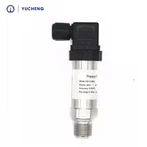
choose a pressure transmitter (二)

5. What kind of output signal needs to be obtained: mV, V, mA and frequency output digital output, the choice of output depends on many factors, including the distance between the transmitter and the system controller or display, whether there is "noise" or Other electronic interference signals. Do you need an amplifier, the location of the amplifier, etc. For many OEM devices with a short distance between the transmitter and the controller, the mA output transmitter is the most economical and effective solution. If the output signal needs to be amplified, it is best to use a transmitter with built-in amplification. For long-distance transmission or strong electronic interference signals, it is best to use mA-level output or frequency output. If you are in an environment with high RFI or EMI indicators, in addition to choosing mA or frequency output, you must also consider special protection or filters. (Currently due to various acquisition needs, there are many kinds of output signals of pressure transmitters on the market, mainly 4...20mA, 0...20mA, 0...10V, 0...5V, etc. , But the more commonly used ones are 4...20mA and 0...10V. Among the output signals I mentioned above, only 4...20mA is a two-wire system. The output we are talking about is a few-wire system. Does not include grounding or shielding wire, others are three-wire system)
6. What kind of excitation voltage to choose: The type of output signal determines what kind of excitation voltage to choose. Many amplifying transmitters have built-in voltage regulators. A working voltage that can be obtained determines whether to use a sensor with a regulator. When choosing a transmitter, the working voltage and system cost must be considered comprehensively.
7. Do you need interchangeable transmitters: Determine whether the required transmitters can adapt to multiple use systems. Generally speaking, this is very important. Especially for OEM products. Once the product is delivered to the customer, the cost for the customer to calibrate is considerable. If the product has good interchangeability, even if the transmitter used is changed, the effect of the entire system will not be affected.
8. The transmitter needs to maintain stability after overtime work: most transmitters will have "drift" after overtime work, so it is necessary to understand the stability of the transmitter before buying. This kind of pre-work can Reduce all kinds of troubles in future use.
9. The package of the transmitter: The package of the transmitter is especially easy to overlook its frame, but this will gradually expose its shortcomings in future use. When purchasing a transmitter, you must consider the working environment of the transmitter in the future, how the humidity is, how to install the transmitter, and whether there will be strong impact or vibration.
10. What kind of connection is used between the transmitter and other electronic equipment: Is it necessary to use a short-distance connection? If a long-distance connection is used, do I need to use a connector?
11. Others: After we determine some of the above parameters, we must confirm the process connection interface of your pressure transmitter and the power supply voltage of the pressure transmitter; if it is used in special occasions, also consider the explosion-proof and protection level.