Electromagnetic flow meter for sewage
The electromagnetic flowmeter is applicable to the process flow measurement and control of industrial and agricultural production companies such as chemical additives, Sponge city, water supply and drainage, water conservancy irrigation, water treatment, sewage treatment (environmental protection sewage control, chemical sewage, electroplating sewage), paper pulp (pulp), slurry, pharmaceutical raw materials, food, etc., with 485 communication function as standard configuration. CN9
Measurement accuracy: ± 0.5% of the measured value (flow rate ≥ 1m/s); ± 0.5% ± 2mm/s of the measured value (flow rate<1m/s);
Output signals: current (4-20mA), pulse, frequency, RS-485;
Protection level: IP65.

Flow caliber comparison table

Installation of electromagnetic flow meter

Lower assemble position
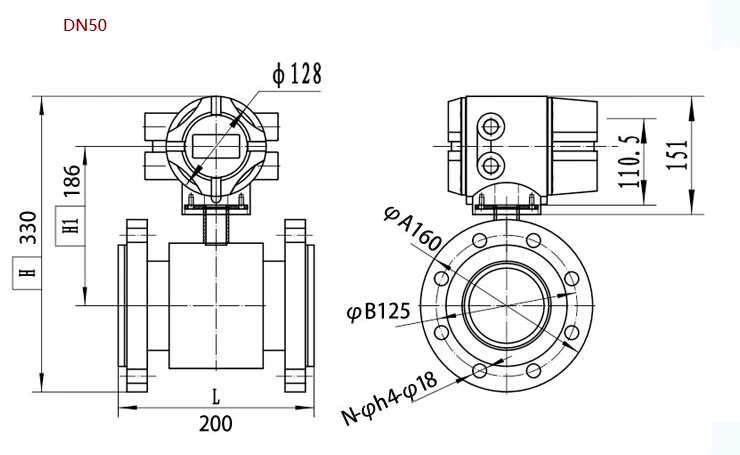
DN50 size drawing
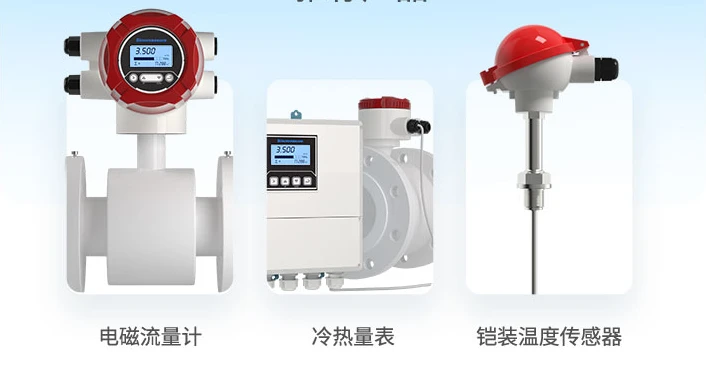
Series products
A. The installation site should not have large vibration sources, and reinforcement measures should be taken to stabilize the pipelines near the instruments;
B. Cannot be installed near large transformers, motors, pumps, and other equipment that generate large magnetic fields to avoid interference from electromagnetic fields;
C. The sensor should be connected to the pipeline to ensure full pipe operation, preferably installed vertically;
D. The transmitter casing, shielded cable, measurement body, and pipes at both ends should be grounded. The grounding electrode should be set separately, and the grounding resistance should be less than 10 ohms. It cannot be connected to the electrical or public grounding network;
E. A straight pipe section with the first 5 times and then 3 times the pipe diameter is required.
The detailed explanation is as follows:
If there is a steady-state eddy current in the measurement area, it will affect the stability and accuracy of the measurement. At this point, the length of the front and rear straight pipe sections can be increased, a flow stabilizer can be used, or the cross-section of the measurement point can be reduced to stabilize the flow velocity distribution.
The flowmeter can be installed horizontally and vertically, but it should be ensured to avoid the influence of sediment and bubbles on the measuring electrode, and it is better to keep the electrode axis horizontal. When installed vertically, the fluid should flow from bottom to top.
The sensor cannot be installed at the highest position of the pipeline, which is prone to the accumulation of bubbles.
Ensure that the flow sensor is filled with the measured fluid in the pipeline during measurement, and there should be no non full pipeline state.
If the pipeline is not full or the outlet is empty, the sensor should be installed on a siphon pipe.