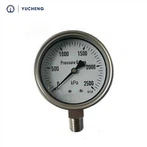
Fault detection of differential pressure transmitter

Title

Title
Fault debugging steps
1. Check if the power supply of the differential pressure transmitter is connected backwards and if the positive and negative poles of the power supply are connected correctly.
2. Measure whether the power supply of the transmitter has a 24V DC voltage; It is necessary to ensure that the power supply voltage to the transmitter is ≥ 12V (i.e., the input voltage of the transmitter power supply is ≥ 12V). If there is no power supply, check whether the circuit is disconnected, whether the detection instrument is selected incorrectly (input impedance should be ≤ 250 Ω), and so on.
3. If the pressure transmitter is equipped with a gauge head, it is necessary to check whether the gauge head is damaged (the two wires of the gauge head can be short circuited first, and if the short circuit is normal, it indicates that the gauge head is damaged). If the gauge head is damaged, it is necessary to replace the gauge head.
4. If there is a problem with the differential pressure transmitter, the ammeter can be connected in series to the 24V power circuit to check if the current is normal. If it is normal, it indicates that the transmitter is normal. At this time, it is necessary to check whether other instruments in the circuit are normal.
5. Is the power supply connected to the input terminal of the transmitter power supply? Connect the power cord to the power wiring port.
fault detect,
When detecting differential pressure transmitter faults, it is important to understand the working principle of the differential pressure transmitter in order to facilitate and quickly identify the cause.
Working principle of differential pressure transmitter: The differential pressure from the dual pressure pipes directly acts on the dual isolation diaphragm of the transmitter sensor, and is transmitted to the measuring element through the sealing liquid inside the diaphragm. The measuring element converts the measured differential pressure signal into the corresponding electrical signal and transmits it to the converter. After amplification and other processing, it becomes a standard electrical signal output.
Several common and practical measurement methods for differential pressure transmitters:
1. Combined with the throttling element, the liquid flow rate is measured using the differential pressure value generated before and after the throttling element.
2. Measure the height of a liquid by utilizing the pressure difference generated by its own gravity.
3. Directly measure the pressure difference of different pipelines and tank liquids.
During the measurement process of transmitters, some faults often occur. Timely diagnosis, analysis, and handling of faults are crucial for ongoing production. We have summarized and summarized some judgment and analysis methods and processes based on our experience in daily maintenance.