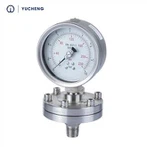
Introduction to the main component categories of pressure gauge measurement
The stainless steel pressure gauge cannot correctly indicate the pressure value, and the indication will be inaccurate. Severe vibration will directly cause the deformation of the elastic element of the pressure gauge and the damage of the parts, which will affect the sensitivity, accuracy level and user's indication of the pressure gauge To read the value, the anti-vibration measures of the pressure gauge are mainly to install a buffer device or choose a shock-resistant pressure gauge.

The main component measured by the pressure gauge is its internal spring tube. When the operating temperature deviates from 20℃±5℃, the elastic component of the pressure gauge—the metal spring tube will change its elastic modulus under the action of temperature, and the pressure gauge will cause the spring tube The displacement of the pipe end produces additional temperature changes, which affect the measurement accuracy of the pressure gauge. During the use of the pressure gauge, it is necessary to minimize the influence of temperature on the accuracy of the pressure gauge. A very direct and effective method is to avoid the pressure gauge from working in an abnormal temperature environment. If it is unavoidable, the pressure gauge should be protected from high temperature or cold, such as installing a condensing device or heat preservation device for the pressure gauge.
The overload operation of the pressure gauge does not only mean that the indication value of the pressure gauge reaches a large scale. In fact, when the pressure gauge exceeds 2/3 of the full scale, the elastic element of the pressure gauge is already in a non-linear state. When working for a long time under overload, its internal elastic elements such as spring tube will be deformed due to the long-term or near-limit deformation state, and cannot correctly indicate the pressure value. The pressure gauge overload measures are higher. A pressure gauge with one range.
Pressure gauges can be divided into precision pressure gauges, general pressure gauges,
and precision pressure gauges according to their measurement degrees. The measurement degrees of precision pressure gauges are 0.1, 0.16, 0.25, and 0.4 respectively. The measurement degrees of general pressure gauges are 1.0, respectively. 1.6, vibration-resistant pressure gauge 2.5, 4.0 level.
Pressure gauges are divided into general pressure gauges, *pressure gauges, and differential pressure gauges according to their different standards for indicating pressure. General pressure gauges are based on atmospheric pressure, absolute pressure gauges are based on *pressure zero, and differential pressure gauges measure two The difference between the measured pressures.
The shell of the shock-resistant pressure gauge is made of a fully sealed structure, and the shell is filled with damping oil. Due to its damping effect, it can be used in the measurement place of working environment vibration or medium pressure (load) pulsation.
The electric contact pressure gauge with electric contact control switch can realize the alarm or control function.