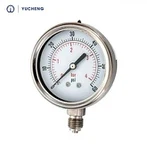
Maintenance of common faults of pressure gauge

Due to their different structural principles, the maintenance methods of various instruments in actual operation are also different. We have talked about Huihua special instruments in previous articles. Today we will talk about the maintenance of pressure gauges.
There are many models of on-site pressure gauges to choose from according to the installation conditions and different measuring media. The most commonly used are spring tube pressure gauges, as well as stainless steel pressure gauges, shock resistant pressure gauges and diaphragm pressure gauges. Regardless of the structure of these pressure gauges, problems or the need to know their accuracy, they all need an instrument pressure calibrator.
The most common problem of the on-site pressure gauge is that the pressure indication is inaccurate, and there will be problems such as high or low display, and the indication does not return to zero. Most of these problems are based on experience. The on-site staff tell the maintenance personnel that a pressure gauge is broken and needs to be repaired, so the instrument personnel should disassemble it and send it to the calibration room for maintenance. When disassembling the pressure gauge, you can roughly determine what the problem is. For example, if the indication does not return to zero, the gauge needle of the pressure gauge still has an indication after disassembly. Of course, this situation may also be misjudged, which may be caused by the viscous medium in the spring tube. In addition, pay attention to the fact that the pointer does not return to zero because the pressure valve is not tightly closed during disassembly. Before disassembling the pressure gauge at the pump outlet, pressure relief and blowdown shall be carried out to prevent medium leakage.
The disassembled pressure gauge can only be further repaired after the medium in the spring tube is discharged. The first is to completely reset the spring tube, and the second is to make the pressure gauge clean so that dirty media do not pollute other equipment.
When the pressure gauge is calibrated, connect it to the calibration interface and check whether the indication and accuracy are accurate according to the pressure calibration steps. If it is inaccurate, make corresponding adjustment. If all adjustments cannot meet the requirements, the spring tube will be scrapped, and other parts can be used as accessories according to the specific situation.