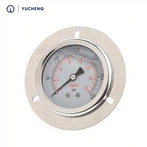
When installing pressure gauges, for the convenience of observation, install them in the most eye-catching place with adequate lighting and avoid being affected by radiant heat, low temperature and vibration. Pressure gauges installed in high places should be tilted slightly forward, but not more than 30°. Pressure gauge nozzle should be directly connected with the container body. Three-way cocks should be installed between the pressure gauge and the container for easy replacement and calibration. The cocks shall be installed in the vertical pipe section and shall be marked open for verification and replacement. Steam vessel shall be equipped with trap pipe between pressure gauge and vessel. Container containing high temperature, strong corrosion and condensation medium, pressure gauge and container should be equipped with isolation buffer device.
The pressure gauge in use, should be based on the highest working pressure of the equipment, on its dial draw a warning red line, but do not paint on the dial glass, so as not to make the operator have an illusion of glass rotation, causing accidents.
Pressure gauges that have not passed the inspection and have no lead seal are not allowed to be installed and used.
The pressure gauge should be kept clean, the glass on the dial should be bright and transparent, so that the pressure value indicated by the pointer in the table can be clearly seen. The nozzle of the pressure gauge should be cleaned regularly. During the operation of the container, if it is found that the indicator of the pressure gauge fails, the scale is not clear, the glass of the dial is broken, the pointer does not return to zero after pressure relief and the lead seal is damaged, it should be corrected or replaced immediately.