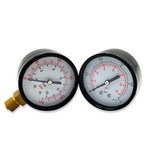
How to measure the depth of a dual pointer thermometer?

Measurement method for insertion depth of bimetallic thermometer
The insertion depth of bimetallic thermometers has a significant impact on their measurement accuracy. The following are the specific measurement steps:
The basic principle for determining the insertion depth is that, generally speaking, a length of at least 50mm is required from the tail of the temperature sensing tube. This length ensures that the bimetallic strip can fully contact the measured object, thereby reducing measurement errors.
Consider measuring temperature range: Different temperature ranges determine the length of the bimetallic sensing strip. Therefore, when choosing the insertion depth, it is necessary to consider the temperature range being measured.
Consider installation method: If the bimetallic thermometer is installed on a pipeline and there are connecting bases or flanges and other accessories on the pipeline, the length of these accessories also needs to be taken into consideration.
Insertion depth under special circumstances: For some special circumstances, such as measuring container temperature or measuring the temperature of high temperature, high pressure, and high-speed fluids, the insertion depth needs to be determined according to the specific situation. For example, if it is necessary to measure the temperature of the flue gas inside the flue, even if the flue diameter is 4m, the insertion depth of the thermistor is 1m.
Calculate the insertion depth using the formula: insertion depth=instrument connector length+pipe wall thickness+immersion length; Increase by 40mm when measuring liquids and 25mm when measuring gases.
In summary, when measuring the insertion depth of bimetallic thermometers, multiple factors need to be considered comprehensively, and the most suitable insertion depth should be determined based on specific circumstances