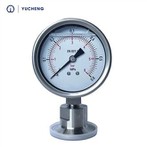
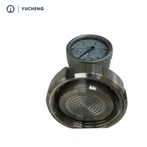
Things to consider when choosing a diaphragm pressure gauge
Diaphragm pressure gauges are mainly used for the pressure of fluid flow media in the production process of petrochemical, alkali, chemical fiber, dyeing, pharmacy, food and dairy industries.

Things you need to consider when choosing a diaphragm pressure gauge:
The application of diaphragm pressure gauges is becoming more and more common, and the types and styles are becoming more and more diversified. How should users distinguish when purchasing? Under normal circumstances, the spring tube of a diaphragm pressure gauge has a certain cross-sectional shape. There are two common types: flat round and approximately elliptical, curved into a "C" shape, and can meet certain elastic requirements.
The performance and size of the spring tube will directly affect the performance of the diaphragm pressure gauge. For example, if its size is too small, the accuracy of the pressure gauge will not meet the standard. In addition, if the indication value of the meter is found to exceed the allowable error, then the indicating value adjustment screw of the meter needs to be adjusted in time. If the meter has no indicating value adjustment screw, then the meter can be judged as unqualified.
Under normal circumstances, the dial graduation line of a qualified diaphragm pressure gauge should be uniform, and the pointer indicating end should be able to cover 1/3 to 2/3 of the length of the short graduation line. If the meter is equipped with a stop pin, then under no pressure or vacuum conditions, its pointer should be close to the stop pin, and the "indentation" must not exceed the specified allowable error.
In addition, we also need to look at the case of the diaphragm pressure gauge. The case should be able to protect the internal parts from contamination. In addition, the instrument should be equipped with safety holes, and dust-proof devices should be installed on the safety holes. Of course, when we buy a diaphragm pressure gauge, we also need to consider the rationality of the overall structure of the instrument, the material selected, the aging process of the electronic components, and the long-term stability.
Precautions for use:
1. The installation position of the diaphragm pressure gauge must correspond to the installation position in the precautions of the pressure gauge operation manual.
2. The pressure gauge should select the appropriate interface form, diaphragm material, and gasket material according to the nature of the measured medium. When used in situations with strong vibration and medium pressure pulses, it should be equipped with a shock-resistant pressure gauge. When the pressure gauge is put into operation under pressure, the valve should be opened slowly and evenly.