Common industrial pressure gauges include Bourdon Tube Pressure Gauges, Switch Pressure Gauge, seismic pressure gauges, digital pressure gauges, explosion-proof pressure gauges, fire extinguisher pressure gauges and special pressure gauges for gas fire extinguishing.
1. Bourdon Tube Pressure Gauge: The elastic deformation of the spring tube under the pressure of the inner cavity medium uses its elastic properties to convert the pressure into the elastic displacement of the free end of the spring tube, and then amplifies it through the gear transmission mechanism of the pressure gauge. The pressure gauge will display the relative value (high or low) relative to the atmospheric pressure. The pressure value within the measuring range is displayed by the pointer.
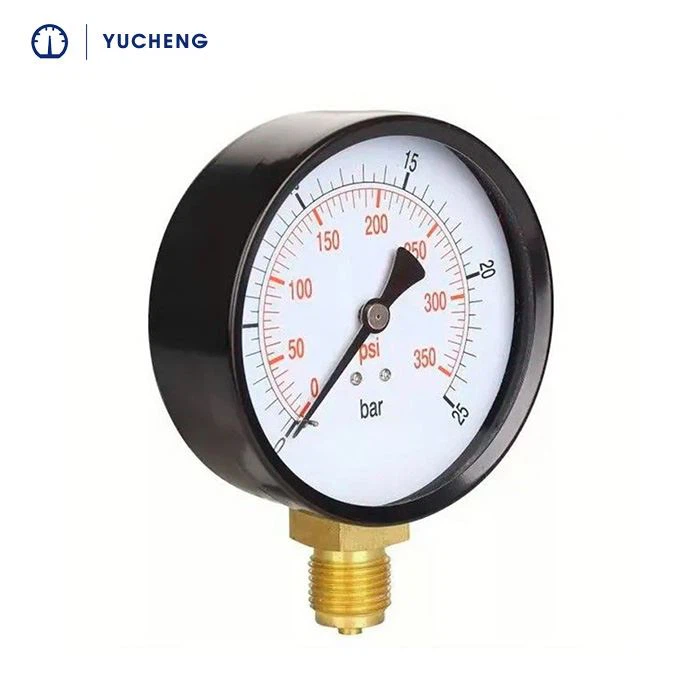
Bourdon Tube Pressure Gauge
2. Electrical Contact Pressure Gauge: Pressure Switch Gauge are often used in fire protection systems, so it is very important to understand the working principle of electric contact pressure gauges, which is also very helpful for the actual application of pressure gauges. There are three pointers on the Pressure Switch Gauge, namely: the black pointer is the current pressure indicator pointer (when the actual pressure is applied, this pointer will rise or fall with the change of pressure); the green pointer is the lower limit pointer (the minimum pressure required for actual pressure application is adjusted by this pointer); the red pointer is the upper limit pointer (the maximum pressure required for actual pressure application is adjusted by this pointer).
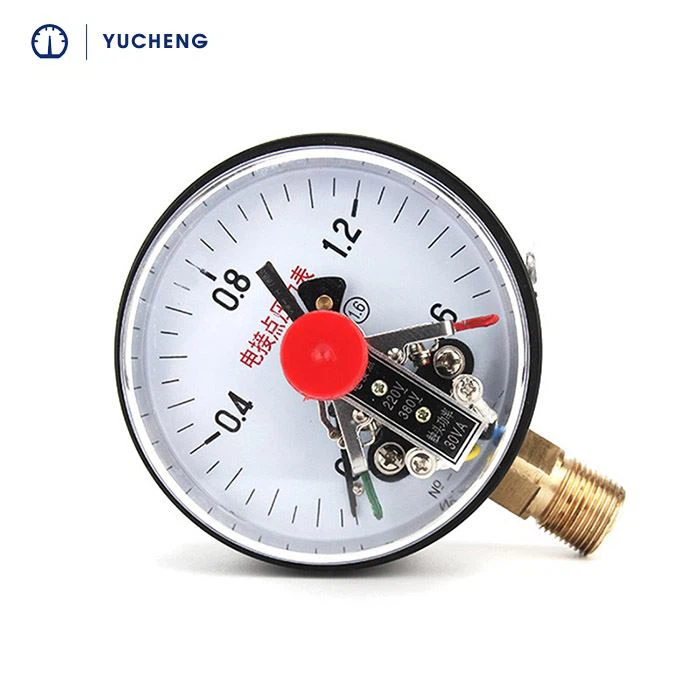
Electrical Contact Pressure Gauge
3. Shockproof pressure gauge: The shockproof pressure gauge is based on the ordinary pressure gauge, with damping fluid filled inside and a buffer mechanism installed to reduce the impact of severe environmental vibration and medium pulse on the instrument, ensuring that the pressure gauge indicates stable and clear.
4. Digital pressure gauge: The digital pressure gauge is a new product in the pressure gauge market with unique performance. It is used to display, monitor and remotely transmit the pressure-related operation process in various machine devices. The pressure to be measured is measured by a ceramic or stainless steel sensor and displayed by an electronic meter head.
5. Explosion-proof pressure gauge: The explosion-proof shell of the explosion-proof pressure gauge has good explosion-proof performance. Therefore, the explosion-proof electric contact pressure gauge can withstand the explosion pressure generated by the explosive gas mixture inside the shell once an explosion occurs due to the influence of sparks or arcs during normal operation, and can effectively prevent the heat energy generated from spreading smoothly outward, and can only slowly spread outward along the tiny gap of the explosion-proof joint surface inside the shell. At this time, the instantaneous temperature transmitted to the outside of the shell has dropped below the ignition temperature of the explosive gas mixture, so it will not cause explosion.
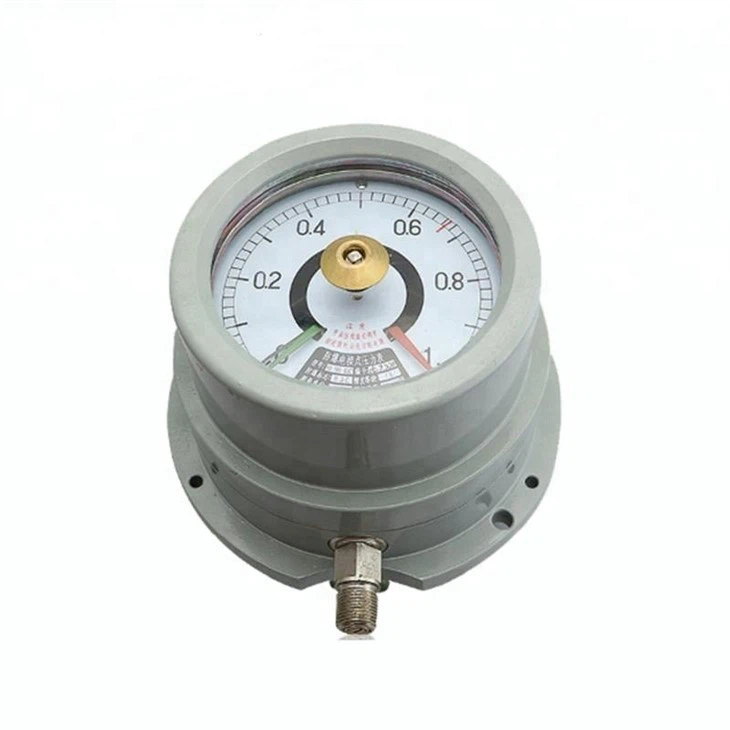
Explosion-proof pressure gauge
6. Fire extinguisher pressure gauge: ① The red area is the failure area. The pressure gauge pointer points to the red area, indicating that the pressure in the fire extinguisher is relatively small. Too low pressure will cause the dry powder and other fillers in the fire extinguisher to fail to spray out normally. ② The yellow area is the danger zone. The pressure gauge pointer points to the yellow area, indicating that the pressure in the fire extinguisher is too high, and there is a risk of explosion if it continues to be used. ③ The green area is the safe area. The pressure gauge pointer points to the green area, indicating that the pressure in the fire extinguisher is normal, and the fire extinguisher can be used normally within this pressure range.
7. Special pressure gauge for gas fire extinguishing: Special pressure gauge for gas fire extinguishing is an instrument used to monitor the medium pressure in the bottle group or pipeline of the fire extinguishing system (such as HFC-227ea, IG541, carbon dioxide, etc.). It is usually designed to be shock-resistant and corrosion-resistant, with high precision and stability. Its dial is marked with a normal pressure range mark (such as the green area), which can intuitively display the pressure status to ensure that the system is in an effective standby state. Some models are equipped with an electric contact function that can be linked to an alarm device. The pressure gauge must comply with relevant fire certification standards and be inspected regularly to ensure reliability. It is a key component for the safe operation of the gas fire extinguishing system.
Note: To prevent the pressure gauge and the pressure gauge valve core from bursting and injuring people, do not loosen the pressure gauge nut completely when checking the pressure!
These pressure gauges are uniformly industrial pressure gauges, but they can be further subdivided according to functions, application scenarios and special needs:
According to the measurement principle: spring tube pressure gauge (mechanical), digital pressure gauge (electronic).
By function: Pressure Switch Gauge (with signal output), explosion-proof pressure gauge (suitable for flammable and explosive environments).
By application:
Seismic pressure gauge (high vibration environment)
Fire extinguisher pressure gauge (ordinary fire extinguisher)
Special pressure gauge for gas fire extinguishing (high pressure, inert gas or chemical fire extinguishing system)
They are all used to monitor fluid pressure, but the design, accuracy and certification standards vary depending on the purpose and need to be selected according to specific working conditions.