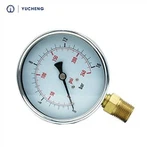
What does the pressure gauge display information based on

1. The basic principle of the internal structure of the pressure gauge:
The Bourdon tube photoresistor is a ductile C-shaped tube with a curved ring shape and an elliptical cross section. *The function of measuring the working pressure of the substance is on the inner side of the undulating tube, so that the elliptical cross section of the Bourdon tube will tend to the circular cross section. Because of the slight deformation of the Bourdon tube, a certain hoop stress is generated. This ring ground stress causes the Bourdon tube to widen outwards. Because the top of the ductile Bourdon tube head is not fixed, it will cause a small deformation. The size of the deformation is to measure the working pressure of the material. The deformation of the Bourdon tube indirectly measures the working pressure of the substance according to the information displayed by the hands of the watch movement.
2. Basic principle of playing yellow tube (Bourdon tube):
Principle of Bourdon tube: The cross-section is elliptical, curved "C"-shaped, convoluted or spiral, one end of which is airtight, and the other end is connected to a pressure source, generally a thin tube. The working pressure flow (vapor or liquid) acts on the thickness of the wall, making its cross section rounded, and also making the bent pipe slightly straight.
3. In particular:
Special pressure gauges should be used for the vapor of flammable and explosive materials, and the oil must be removed to avoid fire and explosion. Corrosive substances must use protective pressure gauges.
The front-end development of the pressure gauge in high-temperature places must be equipped with a condensing tube, and an extension tube must be set in the ultra-low temperature place to prevent the high and low temperature test from damaging the instrument panel components.
Under normal circumstances, the pressure gauge can be applied to vapor or liquid.