


How to choose the most suitable pressure gauge
 |
 |
There are two main types of pressure gauges, one is mechanical, and the other is electronic. Now let me talk about mechanical pressure gauges. Mechanical pressure gauges are divided into Bourdon tube pressure gauges, capsule pressure gauges, differential pressure gauges, diaphragm pressure gauges, diaphragm pressure gauges, and so on. In practical work, selection generally requires confirmation of the following parameters:
First, dial diameter
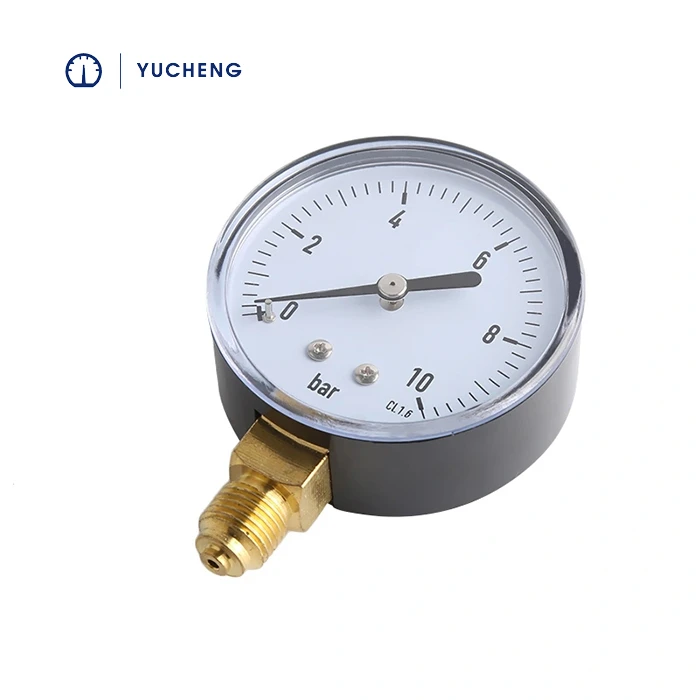
The diameter of the dial is the diameter of the outer casing of the pressure gauge that we can default to. Generally, the commonly used ones are 50mm, 63mm, 100mm, and 150mm (I list them according to European standards, which may be slightly different in China and other countries)
Secondly, shell material
The shell materials of general pressure gauges include ABS (engineering plastic), carbon steel, 304 stainless steel, and copper alloy. We need to choose the shell material of the pressure gauge based on the specific environment. ABS and 304 stainless steel are commonly used.
Thirdly, connection method
The connection methods of pressure gauges are divided into two types: axial (back connection) and radial (bottom connection). However, in reality, customers can choose some options based on specific situations. If it is panel mounted, the axial type can choose the front flange edge or rear fixed bracket, while the radial type can choose the front flange edge or rear fixed edge, and so on.
Fourth, measurement medium
There are generally only two types of liquid connection materials for pressure gauges (standard), namely copper alloy and 304 stainless steel. If the medium you are measuring is not suitable or corrosive to these two types, Then a pressure gauge can be used together with a chemical seal (the function of chemical seal is to effectively prevent contact between the measuring medium and the measuring element without affecting the measurement of medium pressure by the pressure measuring element, thereby protecting the measuring element and extending its lifespan)
Fifth, liquid filling
We have found in some environments with high mechanical vibrations that many pressure gauge dials are filled with liquid. In fact, the main function of these liquids is to increase resistance and effectively prevent the pointer of the pressure gauge from constantly vibrating, so that we can accurately read the pressure value. Usually used near pumps or in environments with severe vibrations.
Sixth, medium temperature
The maximum measurement medium temperature for copper alloy measuring elements is+80 degrees Celsius, while for stainless steel, it is+200 degrees Celsius; But if you choose a pressure gauge that is liquid filled and shockproof, the maximum temperature of the medium at this time can only reach+100 degrees; If the temperature is too high but also shockproof, the method we use is condensation bending.
Seventh, Range Range
Due to the fact that a pressure gauge displays the pressure value by measuring the deformation of the component and driving the pointer to rotate through an amplification mechanism, we should also pay attention when selecting the measurement range. Generally, the maximum pressure measured is 3/4 or 2/3 of the range of the pressure gauge, which is the most ideal. If selected too large, the pointer change will be small, and the pressure value read out will be inaccurate. If selected too small, the pressure gauge will be damaged due to overload.
Eighth, Connection Size
Nowadays, due to the different thread standards in various countries, the main commonly used ones are M (metric system), G (British system), NPT (American system), and R (more commonly used in Japan and South Korea


