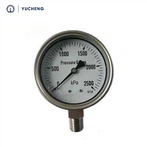
Introduction of anti-corrosion methods for pressure gauges
Nowadays, pressure gauges are widely used in various industries. When measuring corrosive media for pressure gauges, it is very important in maintenance to protect the pressure gauges, so that the value of the pressure gauges can be used more. Incisively...

1. If the medium is corrosive to stainless steel and copper, the stainless steel pressure gauge can change the buffer tank to an isolation tank and add a corrosion-resistant isolation fluid. The type of isolation fluid can be selected according to the nature of the tested medium, but it is better to not deteriorate after using it for more than half a year. If ordinary isolation fluid is not applicable, fluorochloro oil can be used as isolation fluid, but the price is very expensive, so the isolation tank should be made small, and the fluorine oil should be recycled for reuse during disassembly and assembly.
2. For general corrosive media, if the stainless steel spring tube can withstand corrosion for 1 to 2 years, it can be used as a pressure gauge for ammonia. When the pressure gauge is installed, the pressure guiding tube should be short, and the buffer coil should be replaced with a buffer tank to prevent impurities Blocked.
3. Diaphragm pressure gauges can be used. The diaphragm pressure gauges currently have molybdenum 2 titanium and tantalum sheets. The pressure is transmitted by methyl silicone oil between the diaphragm and the spring tube. The minimum range can be 0-100kPa. If the diaphragm material is still If it is not resistant to corrosion, a layer of F46 (polyfluoroethylene propylene) diaphragm can be added, but the sensitivity of the instrument is reduced. F46 can also be used as the isolation diaphragm directly, but pay attention to the permeability of the medium. The fluorine oil diaphragm pressure gauge can be used for the transfer fluid, which can play a double isolation role.