What does the "oil" in the pressure gauge do?
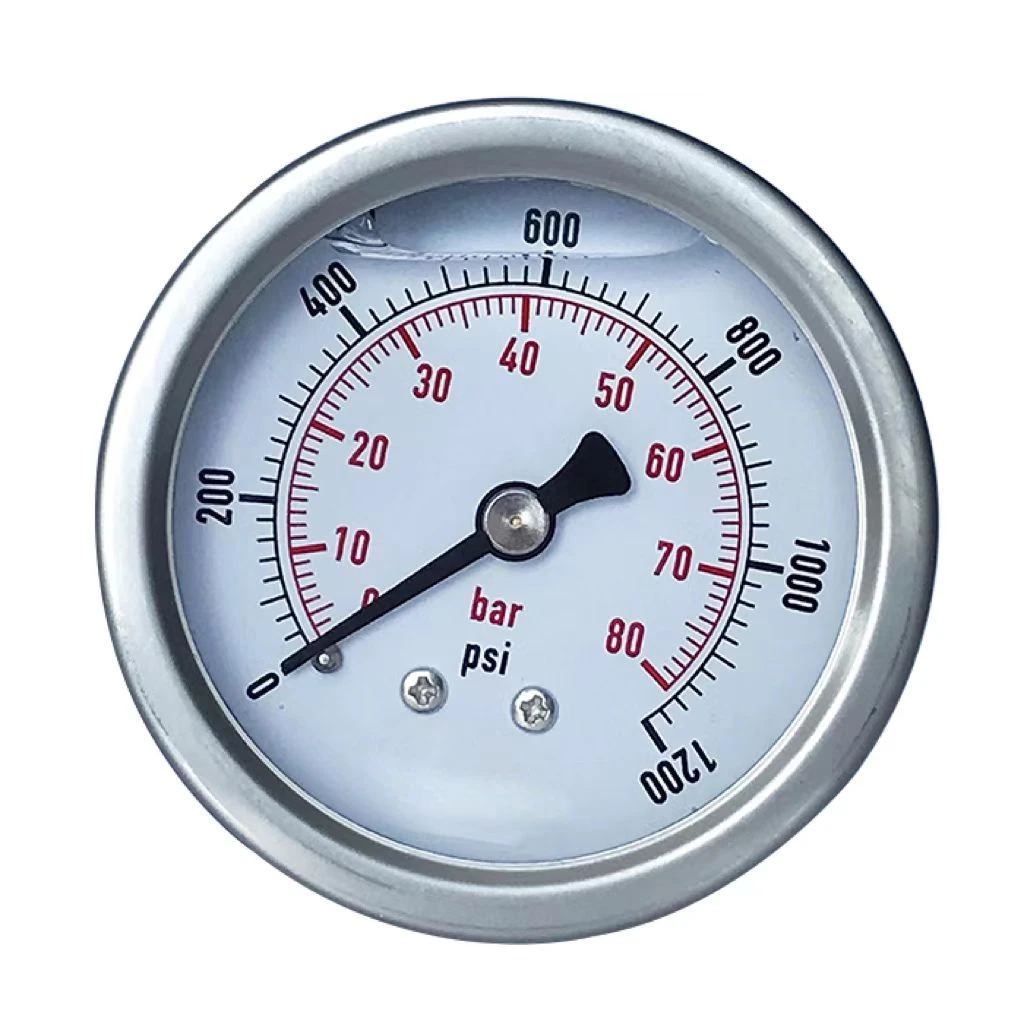
In fact, "oil" plays a stabilizing role in the pressure gauge, in order to prevent the pressure gauge from vibrating, and the pressure gauge added with "oil" is what we often call the "shock-resistant pressure gauge". After adding "oil" to the pressure gauge, the pointer of the pressure gauge will be relatively stable. This kind of pressure gauge is generally used in harsh environments, such as in a noisy environment, or in places where the system pressure fluctuates sharply. It is to prevent the pointer from constantly shaking and affecting the reading of the value. At the same time, adding "oil" to the pressure gauge in a fluctuating environment can prolong the service life of the pressure gauge, because the pointer is constantly shaking, which will definitely reduce the service life of the pressure gauge.
So, do all "vibration-resistant pressure gauges" use one type of oil? No, it's not. There are two main oils used in pressure gauges to stabilize the pointer, one is "glycerin" and the other is "silicone oil." Both kinds of oils can play the role of anti-vibration, but compared to "glycerine", "silicone oil" also has the characteristic of low temperature resistance. If the outdoor temperature reaches minus 20 degrees Celsius, "glycerin" will crystallize, but "silicone oil" will not, so in this environment, the "silicone oil" pressure gauge can still be used normally.
So both glycerin and silicone oil can be used, but at least two points should be considered when making specific choices: 1. The coefficient of thermal expansion, the smaller the coefficient, the better, this is mainly affected by temperature; 2. The occasion of use In the food industry, neither of these two oils can be used. In case the diaphragm is damaged, the oil will contaminate the food. It is also not recommended to measure strong oxidants, otherwise it will cause an explosion.