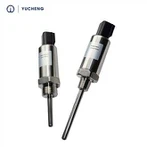
What is a Pressure Sensor?
Definition of Pressure as a Measured Quantity: Pressure is defined as the applied force by a liquid or gas on a surface and it is usually measured in units of force per unit of surface area. Common units are Pascal (Pa), Bar (bar), N/mm2 or psi (pounds per square inch).
Definition of Pressure as a Measured Quantity: Pressure is defined as the applied force by a liquid or gas on a surface and it is usually measured in units of force per unit of surface area. Common units are Pascal (Pa), Bar (bar), N/mm2 or psi (pounds per square inch).
Definition of a Sensor: A sensor is a device that measures a physical quantity and translates it to a signal. The quantity can be for instance temperature, length, force, or – of course – pressure. The signal is in most cases electrical but can also be optical.
Definition of a Pressure Sensor: Therefore, a pressure sensor is an instrument consisting of a pressure sensitive element to determine the actual pressure applied to the sensor (using different working principles) and some components to convert this information into an output signal.

Working Principles of Pressure Sensors
There is a variety of different technologies used within pressure sensors to provide accurate results. The following section will highlight some of these.
Strain gauge based pressure sensors also use a pressure sensitive element where metal strain gauges are glued on or thin film gauges are applied on by sputtering. This measuring element can either be a diaphragm or for metal foil gauges measuring bodies in can-type can also be used. The big advantages of this monolithic can-type design are an improved rigidity and the capability to measure highest pressures of up to 15,000 bar. The electrical connection is normally done via a Wheatstone bridge which allows for a good amplification of the signal and precise and constant measuring results. See our offer of strain gauge based pressure sensors.
Capacitive pressure sensors use a pressure cavity and diaphragm to produce a variable capacitor. The diaphragm is deformed when pressure is applied and capacitance decreases accordingly. This change in capacity can be measured electrically and is then set in relation to the applied pressure. These sensors are limited to low pressures of roughly 40 bar.
Piezo-resistive pressure sensors consist of a diaphragm – mostly made of silicon – with integrated strain gauges to detect strain as a result of applied pressure. These strain gauges are typically configured in a Wheatstone bridge circuit to reduce sensitivity and increase the output. Due to the material being used the pressure limitation is at around 1,000 bar.
Unlike the aforementioned technologies – which all use the deflection of a measuring body – resonant pressure sensors use the changes in resonance frequency in a sensing mechanism to measure stress caused by applied pressure. Depending on the design of these sensors, the resonating element can be exposed to the media, where the resonance frequency then depends on the density of the media. Sometimes these sensors are also sensitive to shocks and vibration.
Other pressure sensors that also do not use a measuring body can be thermal or ionization sensors, which use changes in thermal conductivity due to density changes in the flow of charged particles to measure the applied pressure.