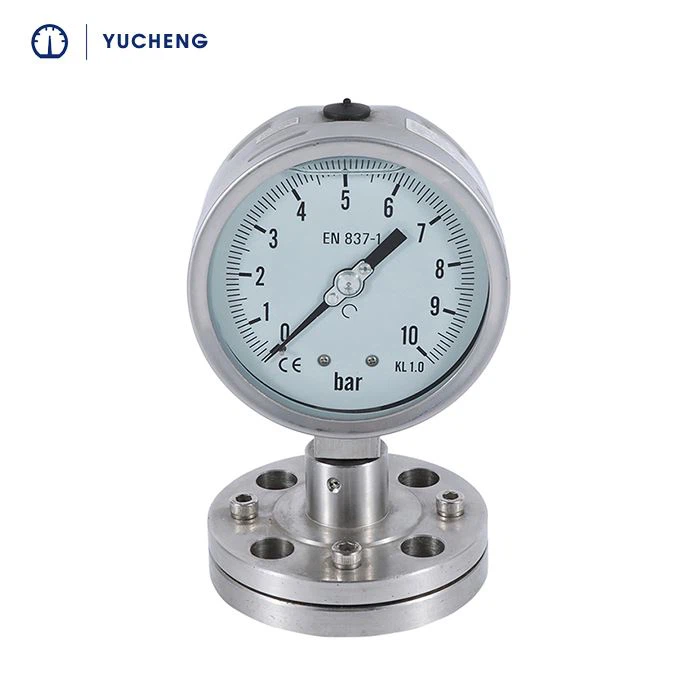
The shock-resistant pressure gauge is based on the ordinary pressure gauge, filled with damping fluid and equipped with a buffer mechanism to reduce the impact of severe environmental vibrations and medium pulses on the instrument. It is widely used in machinery, petroleum, chemical industry, metallurgy, mining, electric power and other departments to measure the medium pressure in places with severe environmental vibrations that can withstand the pulsation, impact and sudden unloading of the medium.
The outer shell has an airtight structure, which can effectively protect the internal components from environmental influences and contaminant intrusion. The shock-resistant pressure gauge is an instrument filled with damping fluid (usually silicone oil or glycerin) in the casing, which can resist the vibration of the working environment and reduce the pulsation effect of the medium pressure.
Installation precautions
1. The ambient temperature of the instrument is -40~70℃, and the relative humidity is not greater than 80%. If it deviates from the normal operating temperature by 20±5℃, the additional temperature error must be included.
2. The instrument must be installed vertically, and strive to be at the same level as the measurement point. If the difference is too high, the additional error caused by the liquid column does not need to be considered when measuring gas. During installation, block the explosion-proof back of the watch case to avoid affecting the explosion-proof performance.
3. The normal measuring range of the instrument: under static pressure, it should not exceed 3/4 of the upper limit of measurement, and under fluctuation, it should not exceed 2/3 of the upper limit of measurement. Under the above two pressure conditions, the minimum measurement of the large pressure gauge should not be less than 1/3 of the lower limit. When measuring vacuum, the entire vacuum part is used.
4. If you encounter problems such as instrument pointer failure, loose internal parts, or failure to work properly during use, you should perform maintenance or contact the manufacturer for repairs.
5. The instrument should avoid vibration and collision to avoid damage.
6. When ordering, please indicate: the instrument model and name; the instrument's measuring range; the instrument's accuracy level deviating from the original packaging requirements and others.
7. Special design according to user requirements.