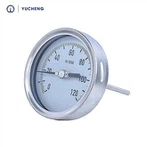
Factors and prevention methods for the service life of pressure gauges
The calculation method for the lifespan of a pressure gauge is different from most products, as it is not based on the length of time, but rather on the use of the core measuring component of the pressure gauge, the Bourdon tube.
Under normal circumstances, when pressure comes in, the Bourdon tube deforms, causing changes in the indicator and displaying the pressure reading. And when the Bourdon tube reaches the number of uses, it will not restore after deformation, causing the pointer to not return to zero or the Bourdon tube to rupture, at which point the service life of the pressure gauge will end.
Of course, if the pressure gauge and Bourdon tube work in a high pressure range for a long time, their deformation frequency will also be reduced, but the impact is not significant, so there is no need to worry too much.
How to extend the service life of a pressure gauge?
Here are common factors and solutions to avoid frequent damage to pressure gauges as much as possible.
Common factor 1: Transient overvoltage
Explanation: This is the most common cause of pressure gauge damage, such as a 16Mpa pressure gauge that instantly exceeds 20Mpa. Almost once this situation occurs, the pressure gauge can no longer be used. Often occurs when the unit is shut down without paying attention to residual pressure, and then restarted.
Solution: Choose a pressure gauge with a larger measurement range, or after the unit is shut down, let it stand for a period of time until the pressure completely subsides before restarting.
Common factor 2: System vibration or unstable pressure source
Explanation: When the pressure gauge continuously vibrates or the pressure source is unstable (with uncertain pulses), it will reduce the number of times the Bourdon tube is used, resulting in a shortened service life of the pressure gauge.
Solution: When the vibration amplitude or instability of the pressure source is not significant, an oil filled pressure gauge can be used. But if the system vibrates too much, the pressure gauge must be installed elsewhere and a pressure pipe must be added. When the instability of the pressure source is too high, a pressure buffer can be used to slow down the pulse.
For other questions about oil filling, please refer to the timing of oil filling for pressure gauges/thermometers and common problems after oil filling?
Common factor 3: High working environment temperature
Explanation: It is easy for the pressure gauge sensing element to deform due to heat or for the outer coating to melt
Solution: Install curved pipes or heat dissipation pipes to lower the temperature, allowing the high-temperature pressure source to cool down before coming into contact with the pressure gauge.
Common factor 4: Highly corrosive working environment
Explanation: Some sensing components of pressure gauges are less corrosion-resistant, and operating in highly corrosive environments can cause damage to their components and render the pressure gauge unusable.
Solution: Use joints made of stainless steel or other corrosion-resistant materials.
Common factor 5: The measured fluid contains impurities
Explanation: Impurities can cause blockages in general pressure gauges, rendering them unusable.
Solution: It is recommended to use a diaphragm pressure gauge