Some users of the bimetal thermometer is not a lot of understanding, there are some trouble in the process of purchasing, do not know how to choose is right. In fact, the method of choice is very simple, if you do not know how to read or purchase before then take a look at the following introduction.
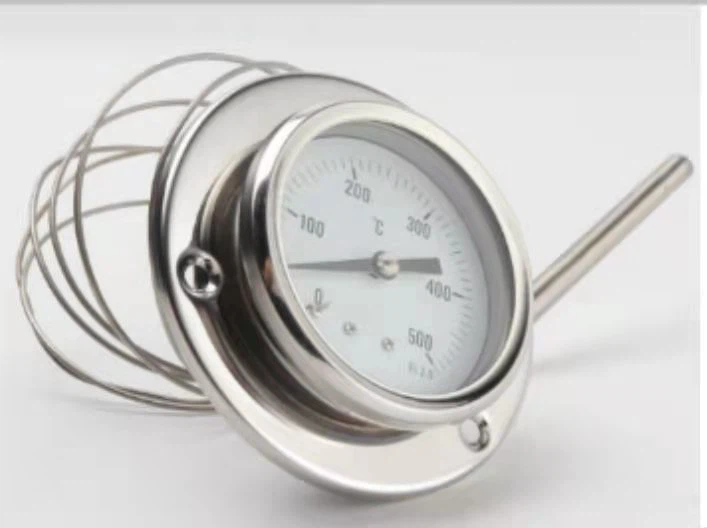
While the bimetallic thermometer is reading, the probe rod of the thermometer must remain in the liquid or gas under test. The length of the protective tube immersed in the medium under test must be greater than the length of the temperature sensing element. Generally, the immersion length must be greater than 100 mm, the immersion length of the 0-50 ° C range is more than 150 mm to ensure the accuracy of the measurement, and the line of sight should be parallel to the dial.
When reading, first look at the range of the bimetal thermometer. The scale is, the range is the measuring range of the thermometer. The scale is the value represented by each cell on the thermometer. It determines the degree of measurement, we usually use a thermometer with a scale of 1 ° C or 2 ° C, and a scale of 1 ° F. The conversion between temperature in Celsius (° C) and temperature in Fahrenheit (° F) is:
F = 9 ° C/5 + 32, or ° C = 5(F-32)/9 ° C; 9/5 + 32 = Fahrenheit.
The above is the correct reading of the bimetallic thermometer methods introduced, I do not know that you read the contents of these whether there are doubts? Keep reading if you have it.
Bimetallic thermometers are becoming more and more useful in our daily life. They can be seen in both home and industrial thermometers. It works by welding together two pieces of metal with very different expansion coefficients. When the temperature changes, the different expansion coefficient causes the different expansion and contraction, which results in the sheet metal bending deformation. According to the different deformation and produce different rotational momentum, rotational momentum connected to the shaft and the other end of the pointer, indicating the temperature.
In general, order bimetallic thermometer usually need to provide the following parameters:
1, confirm the temperature range.
2. Choose dial sizes, usually 60mm, 80mm, 100mm, 150mm, etc. .
3. Choose the connection mode between Dial and temperature sensing tube, usually axial, radial, universal, etc. .
4. confirm the diameter and insertion depth of the temperature sensing tube.
5. Confirm the method of fixing the temperature sensing tube. There are several methods, such as fixed thread, movable thread, sleeve thread, flange fixing, etc. .
6. Check if there are other requirements, such as setting the alarm temperature (bimetal thermometer with electrical contacts) .
7. Confirm thread sizes, usually M16 * 1.5, M27 * 2, G 1/2”, 1/2” NPT, etc. . I believe that after reading these content you can find that in fact, whether it is reading or ordering skills are not very difficult, as long as you can learn to master the heart.