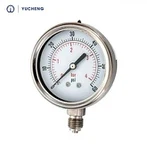
How to prevent corrosion on the stainless steel pressure gauge casing?

Stainless steel pressure gauge

Stainless steel pressure gauge
1. It is recommended to use a stainless steel casing or spray the casing with tetrafluoroethylene to prolong the service life of the pressure gauge in environments with corrosive gases;
2. It is recommended to increase the protection level of the outer shell to prevent moisture from entering the stainless steel pressure gauge model and improve the service life of the pressure gauge.
Corrosion protection of the liquid receiving part:
1. For general corrosive media, if the stainless steel elastic element can withstand 1-2 years of corrosion, the price of the stainless steel pressure gauge can choose a general stainless steel pressure gauge. When installing, the pressure pipe should be short, and if necessary, the buffer coil should be changed to a buffer tank to prevent impurities from blocking.
2. If the medium of the all stainless steel pressure gauge has significant corrosion on stainless steel and copper, the buffer tank can be changed to an isolation tank, and the isolation liquid of the corrosion-resistant all stainless steel pressure gauge can be added. The type of barrier fluid can be selected based on the properties of the tested medium, but it is recommended to use it for more than six months without deterioration. If ordinary isolation liquids are not suitable, fluorochlorine oil can be used as the isolation liquid, but the price is expensive. Therefore, the isolation tank should be made small, and the fluorochlorine oil should be recycled and reused during disassembly and assembly.
3. Diaphragm type pressure gauges can be used. Currently, there are molybdenum containing stainless steel, Hastelloy alloy, and tantalum plates. The pressure is transmitted between the diaphragm and the ballistic tube using methyl silicone oil, with a minimum range of 0-100kPa. If the diaphragm material is not yet corrosion-resistant, a layer of F46 (perfluoroethylene propylene) diaphragm can be added, but the sensitivity of the instrument is reduced. F46 can also be directly used as an isolation membrane, but attention should be paid to the permeability of the medium. Fluorine oil can be used as the transmission fluid for high-temperature and oil-resistant media.