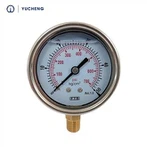
During the installation and use of the pressure gauge, the following items should be paid attention to:
1. Check the instrument type, external nominal diameter, measurement range, accuracy grade, installation method, connection method and size, etc., all should be adapted to the actual working conditions of the installation station.
2. When the normal working environment temperature of the instrument and the temperature of working medium deviate from 20±5℃, the additional error of the corresponding temperature shall be included. When the temperature of the meter exceeds -40℃~70℃, a heat sink in front of the meter should be installed.
3. When the working medium is non-gas, the installation place and the measuring point should be at the same level, otherwise the corresponding liquid level error should be included. At the same time, the distance between the installation location of the instrument and the measuring point should be as short as possible.
4. When loading and unloading the threaded connection type instrument, tools such as wrenches should be used to pull the four sides of the joint. It is forbidden to pull the meter directly to rotate the thread, so as to avoid damage to the meter.
5. When installing the panel-mounted instrument, pay attention to making the pressure guiding internal thread joint and the connecting thread axis of the instrument heavy. When it is not heavy, use strong external force to tighten the thread, which may cause the gauge joint to bear excessive radial external force, and the gauge structure cannot be supported and deformed, which may cause damage to the gauge during installation or operation.
6. For pressure gauges that measure special gas media such as hydrogen and oxygen, pay attention to the corresponding marks on the dial. Oxygen pressure gauges should take corresponding measures and strictly prohibit oil.
7. When measuring strongly corrosive, viscous or possibly crystalline media, a diaphragm pressure gauge should be selected.
8. For flange-connected instruments, attention should be paid to the uniform clearance and pressing force between the lower flanges during installation.
9. The universal flange diaphragm pressure gauge must use the manufacturer's special sealing gasket. When installing, pay attention to make the gasket hold the same weight with the sealing surface of the instrument flange.
10. It is strictly forbidden to loosen the connection thread between the diaphragm pressure gauge head, connector and isolator (generally all have red paint seals), so as to avoid leakage of the diaphragm filling liquid and cause damage to the instrument.
11. The high pressure measured by the instrument does not exceed 3/4 of the measurement limit when the load is stable; when the load is unstable, it does not exceed 2/3 of the measurement limit.
12. The amount of change in the pressure of the measured medium should not exceed 10% of the instrument's measurement limit per second. When the medium pressure changes greatly, with a certain degree of pressure pulse, a shock-resistant pressure gauge should be selected and a damping device should be installed.
13. When the instrument is in trial operation or valve pressure test, pay attention to the slow valve and keep the pressure stable to avoid the instrument being turned off because the pressure greatly exceeds the measurement limit of the instrument.
14. When the working environment vibrates greatly, a shock-resistant pressure gauge should be used.
15. Vibration-proof pressure gauge or fully sealed pressure gauge, after installation, the rubber plug hole on the outer edge of the meter should be used to make the inside of the meter communicate with atmospheric pressure to eliminate additional errors that may be caused by changes in the internal pressure of the meter.
16. For instruments with additional gas devices (such as contacts, remote pressure gauges, etc.), attention should be paid to the matching of gas parameters, and the wiring is correct.
17. The verification period of the instrument generally does not exceed half a year. During operation, if the current accuracy drops, the indication value is unstable, or the pointer jumps and other abnormal conditions, stop immediately and check the cause in time. Only after rechecking the grid can it be used.