


Pressure transducer and pressure transmitter
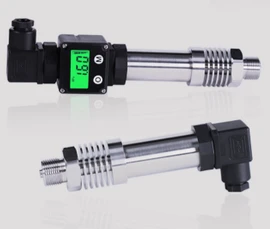
Sensor is to convert a physical quantity to be measured into another physical quantity that can be read and processed. In modern control, this physical quantity is electrical signal; The transmitter is to convert the primary electrical signals of the sensor into standard electrical signals, such as current signals of 4 -- 20mA, 0 -- 20mA, voltage signals of 0 -- 10V, 1 -- 5V. The primary pressure sensor is a millivolt signal change caused by pressure. If the sensor has an amplification and shaping circuit to output a standard current or voltage signal, such a sensor can also be called a pressure transmitter; The name of the pressure transmitter is relative to that of the early pressure sensors which output millivolt signals. Most modern pressure sensors have directly output standard signals, so it is possible to integrate the current pressure sensors and pressure transmitters.
principle
The pressure sensor we usually use is mainly made of piezoelectric effect, which is also called piezoelectric sensor.
As we know, crystal is anisotropic, while amorphous is isotropic. When some crystal medium is deformed by mechanical force along a certain direction, polarization effect occurs; When the mechanical force is removed, it will return to the uncharged state again, that is, when under pressure, some crystals may produce an electrical effect, which is called the polarization effect. According to this effect, scientists have developed a pressure sensor.
The main piezoelectric materials used in piezoelectric sensors include quartz, potassium sodium tartrate and dihydroammonium phosphate. Among them, quartz (silicon dioxide) is a natural crystal. The piezoelectric effect is found in this crystal. Within a certain temperature range, piezoelectric properties always exist, but beyond this range, piezoelectric properties completely disappear (this high temperature is the so-called "Curie point"). As the electric field changes slightly with the change of stress (that is, the piezoelectric coefficient is relatively low), quartz is gradually replaced by other piezoelectric crystals. Potassium sodium tartrate has great piezoelectric sensitivity and piezoelectric coefficient, but it can only be used at room temperature and low humidity. Dihydroammonium phosphate is an artificial crystal, which can withstand high temperature and quite high humidity
It has been widely used.
At present, piezoelectric effect is also applied to polycrystals, such as current piezoelectric ceramics, including barium titanate piezoelectric ceramics, PZT, niobate piezoelectric ceramics, lead magnesium niobate piezoelectric ceramics, and so on.
Piezoelectric effect is the main working principle of piezoelectric sensor. Piezoelectric sensor cannot be used for static measurement, because the charge after being acted by external force can be saved only when the circuit has infinite input impedance. This is not the case in practice, so the piezoelectric sensor can only measure dynamic stress.
Piezoelectric sensors are mainly used in the measurement of acceleration, pressure and force. Piezoelectric accelerometer is a common accelerometer. The utility model has the advantages of simple structure, small volume, light weight, long service life, etc. Piezoelectric accelerometer has been widely used in the vibration and impact measurement of aircraft, automobiles, ships, bridges and buildings, especially in the aviation and aerospace fields. Piezoelectric sensors can also be used to measure the internal combustion pressure and vacuum degree of the engine. It can also be used in the military industry, for example, to measure the change of bore pressure and the shock wave pressure at the muzzle at the moment when a bullet is fired in the bore. It can be used to measure both large and small pressures.
Piezoelectric sensors are also widely used in biomedical measurement. For example, ventricular catheter microphones are made of piezoelectric sensors. Because measuring dynamic pressure is so common, piezoelectric sensors are widely used


