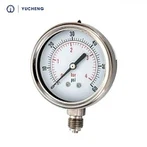
The function of the pressure gauge is to measure and indicate the pressure in the pressure product. If the pressure product does not have a pressure gauge, or the pressure gauge fails, the pressure of the pressure product cannot be expressed, thus directly endangering safety.
A sensitive and accurate pressure gauge is installed on the pressure product, so that the operator can operate the pressure product correctly with the pressure gauge to ensure safe and economical operation.
The pressure gauge can accurately indicate the level of steam pressure in the pressure product. The operator can adjust the heating degree of the product according to the indicated value of the pressure gauge to ensure the requirements of the gas department and the safe operation of the pressure product.

Extended information:
1. Working principle
The pressure gauge transmits the pressure deformation to the pointer through the elastic deformation of the sensitive elements (Bourdon tube, bellows, bellows) in the watch, and then causes the pointer to rotate to display the pressure.
2. Main structure
Overflow hole: In the event of an emergency in which the Bourdon tube bursts,
The internal pressure will be released to the outside through the overflow hole, preventing the glass panel from bursting. Note: In order to maintain the normal performance of the overflow hole, a space of at least 10mm should be reserved behind the table, and the overflow hole cannot be modified or plugged.
Pointers: In addition to standard pointers, other pointers are optional.
Glass panel: In addition to standard glass, other special material glass, such as tempered glass, non-reflective glass is also optional.
Performance classification: ordinary type (standard), ordinary type for steam (M), heat-resistant type (H), vibration-resistant type (V), vibration-resistant type for steam (MV), heat-resistant and vibration-resistant type (HV).
Treatment method: Oil-free / Water-proof treatment Remove the water or oil remaining in the wetted part during manufacture.
Designation of exterior: The shell color should be specified except the standard color.
Throttle valve (optional): To reduce pulsating pressure, a throttle valve is installed at the pressure inlet.
Three, use attention
1. The meter must be vertical: use a 17mm wrench to tighten it during installation, and the case should not be twisted; collisions should be avoided during transportation;
2. The instrument should be used in the ambient temperature of -25~55℃;
3. The vibration frequency of the working environment is less than 25HZ, and the amplitude is not more than 1mm;
4. During use, due to the high ambient temperature, the indication value of the instrument does not return to zero or the indication value is out of tolerance, the sealing rubber plug on the upper part of the case can be cut off to make the inner cavity of the instrument communicate with the atmosphere;
5. The use range of the instrument should be between 1/3 and 2/3 of the upper limit;
6. When measuring corrosive media, media that may crystallize, and media with high viscosity, an isolation device should be added;
7. The instrument should be checked frequently (at least once every three months), and if any fault is found, it should be repaired in time;
8. Instruments for measuring corrosive media should be used, and the requirements should be specified when ordering.